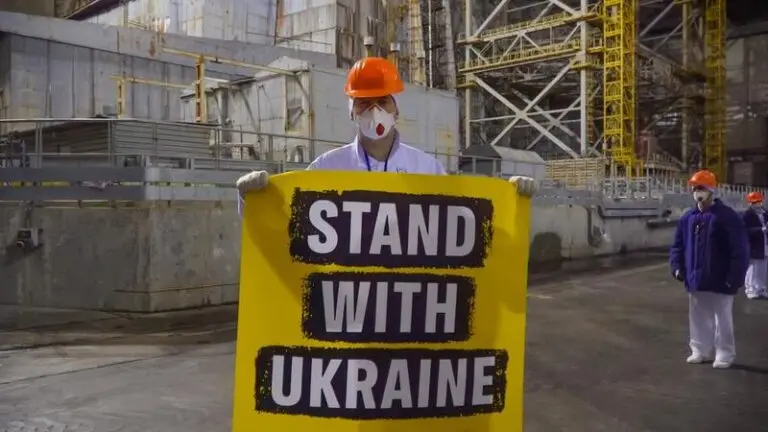









Sunday marks 40 years since the world’s worst nuclear accident. The explosion of reactor four at the Chernobyl nuclear power plant in Ukraine on 26 April 1986 caused an enormous humanitarian and environmental disaster, affecting millions of people across much of Europe. The event and its consequences shook the continent.
Greenpeace’s account cites estimates of around 115,000 cancer deaths associated with radioactive contamination, with thyroid cancer highlighted in particular. It describes leukaemia, cataracts and respiratory, circulatory, digestive and lung conditions among people in the immediately affected area, within a 30-kilometre radius, as well as serious illnesses emerging years later in young people and children. According to the organisation, the worst-affected groups included the clean-up workers known as liquidators, evacuees, residents of contaminated areas and children born to those groups. Around 350,000 people in Ukraine, Russia and Belarus were forced to leave their homes, while approximately five million still live in areas exposed to radiation, it says.
The account describes radioactive contamination across roughly 150,000 square kilometres. Clouds of radioactive material spread across Europe after the reactor explosion, significantly contaminating 14 European countries. When they reached Greece, rain in northern regions and Thessaly was followed by measurements showing high radiation levels.
Greenpeace says radiation remains a threat at Chernobyl, particularly amid the war. It describes the concrete and steel sarcophagus around reactor four as a temporary structure needing reinforcement and replacement. The organisation warns that work has been disrupted by the war and that last year’s Russian drone attack increased the danger to the protective structures. Their collapse could release radioactive dust and fuel remnants, it argues. Continued threats from Russian missiles and drones put the plant and Europe at risk, Greenpeace says.
Although Chernobyl’s consequences have marked the affected regions and the wider world, Greenpeace argues that Europe’s renewed interest in nuclear power overlooks them. The industry is being promoted as environmentally friendly and as a response to the climate crisis, the organisation says.
At a time when nuclear facilities are becoming causes and targets of conflict, including in Ukraine and in tensions involving Israel, the United States and Iran, Greece’s prime minister has said he intends to explore small modular reactors. Greenpeace argues that large and small reactors rely on the same principles and pose the following problems and risks:
• Nuclear power is, in Greenpeace’s assessment, the most expensive form of energy, with hidden costs and greater dependence on the country supplying the technology.
• Nuclear waste must be buried and contained for hundreds of thousands of years.
• Operation requires large volumes of water, whose availability is being reduced by climate change.
• Accidents remain possible through human error, natural disaster and unforeseen events, particularly during geopolitical tensions and conflicts.
Forty years after Chernobyl, Greenpeace argues that nuclear risks are long-lasting and cannot be fully contained, while safer, cheaper and more resilient alternatives exist. It calls on Greece and governments worldwide to focus energy policy on decentralised renewable systems to strengthen security, reduce vulnerability and dependence, and provide a stable energy future. In the organisation’s view, nuclear power has no place in a clean, sustainable and safe energy system.