








The Archipelagos Institute of Marine Conservation says it has submitted a report to the European Public Prosecutor’s Office alleging that at least €52 million intended to support fisheries was diverted into unrelated commercial activities. It describes the sum as substantially larger than amounts disclosed so far in the OPEKEPE scandal.
By Thodoris Tsimpidis
For the Archipelagos Institute of Marine Conservation
t.tsimpidis@archipelago.gr
Much is being said in response to fishermen’s protests. Yet the central issue is missing: genuine fisheries sustainability and the causes of the sector’s dramatic decline in Greece. None of the recently announced measures aims to restore fisheries, in our assessment. Instead, emphasis is placed on digital monitoring and similar tools without measures to protect and rebuild fish stocks or meaningful support for sustainable fishing.
This is a longstanding problem in Greece. According to the report Archipelagos submitted yesterday to the European Public Prosecutor’s Office, at least €52 million earmarked for fisheries sustainability during the previous funding period, under the Fisheries Leader programme, was channelled by the Rural Development Ministry into unrelated businesses. These included cafés, restaurants, veterinary practices, physiotherapy clinics, language schools, gyms and luxury stone-built accommodation with swimming pools. We cannot understand the connection of these activities to fisheries, and neither, we believe, can the relevant European authorities.
The European Public Prosecutor’s Office is now expected to examine the purpose and legality of the calls for proposals and the procedures through which the money was allocated. Archipelagos’s research indicates that Greece was the only country where it identified resources being diverted from their intended purpose.
It is therefore unsurprising, in our view, that Greece also stands out within the EU for the longstanding neglect of fisheries, particularly small-scale coastal fishing. We attribute this not only to political opportunism but also to a lack of understanding among policymakers. Decades of misguided policy and the absence of recovery measures have contributed to depleted stocks and the loss of thousands of jobs, especially in remote areas where employment cannot readily be replaced, leaving families without work or income.
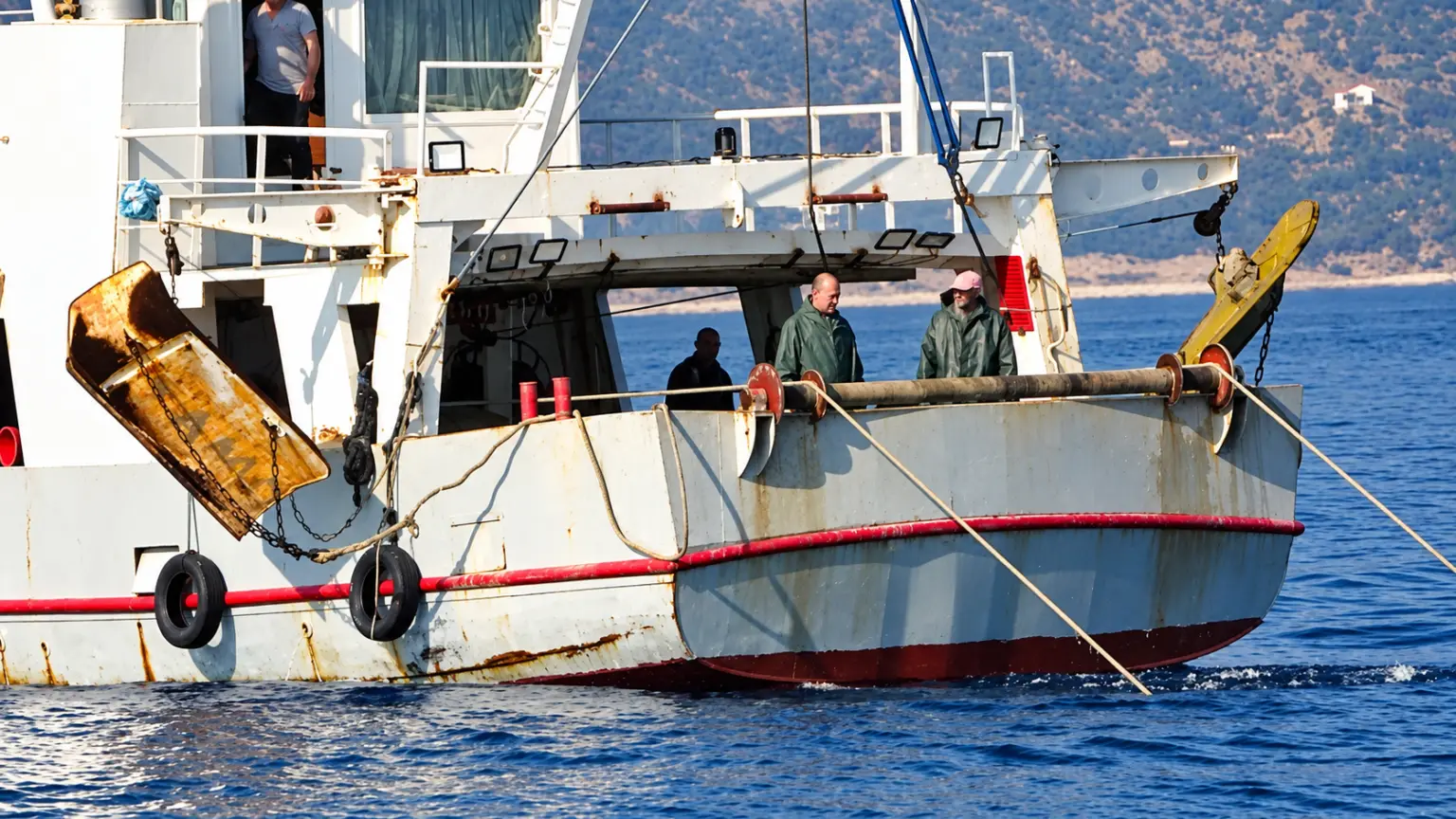
The protests have also exposed confusion in media coverage and public debate, where two very different forms of professional fishing are often treated as equivalent: small-scale coastal fishing and industrial-scale fishing. To illustrate the difference, a coastal vessel using static gear such as nets and longlines may catch less in an entire year than a bottom trawler using heavy metal towed gear catches in one day.
Small-scale coastal fishing has supported island and coastal communities for centuries using broadly similar methods and gear. Today, this sector, vital to local economies, food supply and social cohesion, faces collapse. Small fishing boats are disappearing rapidly across Greece as fishers of all ages leave an unviable profession. Around 13,500 traditional wooden fishing boats have been destroyed through subsidised scrappage programmes in return for small payments. Yet the fishers operating the roughly 11,000 coastal vessels that remain still struggle to support their families along Greece’s extensive coastline.
Industrial-scale fishing, particularly the fleet of 231 bottom trawlers, uses far larger vessels, powerful engines and much greater catching capacity. More significantly, it employs methods whose destructive effects have been known for decades. Gear designed for muddy seabeds has been allowed over productive marine habitats, dragging heavy metal equipment and chains. A single pass can irreparably destroy coral colonies, calcareous algal formations and other valuable ecosystems.
Trawlers also mainly employ foreign crews and send catches to a small number of central fish markets, rather than making them directly available to residents of the islands around which they were caught. Beyond overfishing, the gravest problem is the often irreversible habitat destruction left behind, undermining the capacity of fish stocks to recover.
That destruction is sometimes described, even by trawler representatives, as “ploughing the sea”, a phrase that passes without serious scrutiny from politicians or the media. We also question the privileged access trawler representatives have historically enjoyed to the ministry’s fisheries administration and whose interests the resulting policies serve.
A trawler owner’s statement to the media two days ago illustrates our concern: he argued that taxpayers should subsidise his already tax-free fuel and the wages of his Egyptian fishing workers.
Another major question is how fisheries and catches can be managed while recreational fishing remains outside an effective monitoring framework, despite its large combined catching capacity and substantial electoral constituency.
Alongside lawful recreational fishing for personal consumption, we allege that significant quantities sold to restaurants and elsewhere along Greece’s coast come from recreational fishers, some using illegal methods such as night-time spearfishing with diving equipment, explosives or chemicals.
If we want to discuss the future and sustainability of Greek fisheries, we must address the chronic failings driving their decline. Instead of tackling problems created or worsened by the state and its policymakers, the proposed answer is tablets and tracking devices to record ever-smaller catches, without measures to rebuild stocks or support fishing.
The scheme envisages tracking devices and tablets for 10,743 professional fishing vessels at a public cost of €62.1 million. The ministry presents digital monitoring as a way to protect Greek seas more effectively. We question how buying this expensive equipment, benefiting suppliers and consultants, will help fisheries recover.
Above all, we cannot continue treating the alleged misuse of European funds intended for fisheries sustainability as normal. Those resources could provide a lifeline and establish the foundations for meaningful recovery.
We do not need to invent the methods for rebuilding fisheries and fish stocks. International examples point to a basic first step: let fish and other harvested species reproduce by protecting spawning areas and seasons and prohibiting catches below the size of reproductive maturity. Fishers and coastal residents throughout Greece also demand this. European funding should support those aims rather than unrelated activities labelled as assistance to fishing communities.
We regard reports circulated yesterday about a further fuel subsidy for April and May 2026 as another sign of the ministry leadership’s lack of fisheries understanding and vulnerability to pressure. Those months are the breeding season for many harvested species, when funding should instead support a complete fishing pause.
An unquestionable priority must be the viability of the roughly 11,000 coastal fishing vessels and their essential social, economic and food-supply role in island and coastal communities. Equally necessary is protection of the remaining healthy, productive marine habitats from the approximately 230 bottom trawlers, with meaningful implementation of European safeguards. Rather than operating throughout Greek waters, trawlers should be confined to clearly defined fishing grounds with sandy or muddy bottoms, away from productive ecosystems.