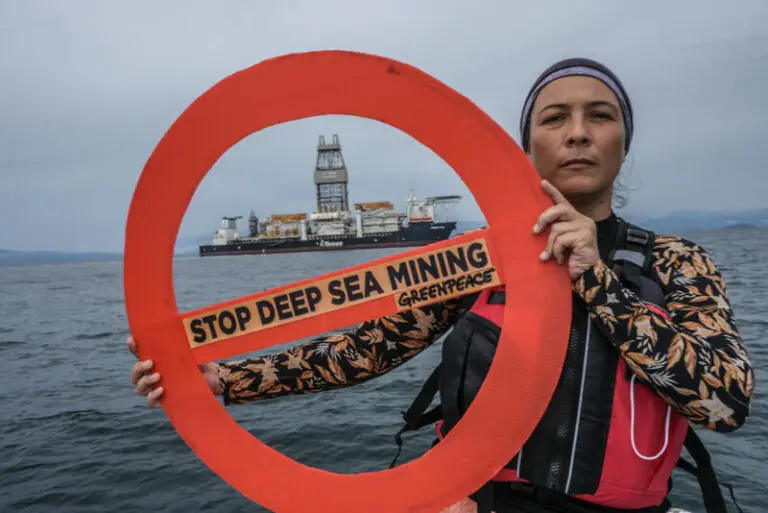










Two weeks of meetings at the International Seabed Authority (ISA) ended on 20 March. Recently, The Metals Company (TMC) and the Trump administration have been pressing for unilateral rights to exploit the deep sea, Greenpeace says.
Governments from around the world met at the ISA to discuss, among other matters, the possibility of granting deep-sea mining licences. Greenpeace welcomed the fact that the meeting ended without licences being issued or a mining code being adopted, describing it as a step in the right direction for the oceans.
Last summer, TMC and the Trump administration met to pursue deep-sea mining rights while seeking to bypass the ISA, and submitted an application under US domestic mining rules dating from the 1980s. Governments have since sought scrutiny of the legality of such an initiative. Greenpeace argues that international waters cannot be appropriated for exploitation by a single country under international law, while the ISA’s mandate is to protect the world’s oceans and permit mining only if it benefits humanity.
Beyond the threat to marine ecosystems, wildlife and the climate, Greenpeace describes these developments as another example of Trump’s drive to deregulate for the benefit of companies and private interests, and to undermine international agreements at a time of multiple crises. The organisation says its investigation identified contractual breaches, which it submitted to the ISA, calling for transparent scrutiny and the defence of international law. At the meeting that has just ended, the ISA decided to continue investigating companies suspected of breaching their contracts.
Greenpeace argues that Trump’s close involvement and intimidation tactics obscure the central issue: that deep-sea mining offers another route to corporate enrichment, with minerals destined for the arms industry rather than the green transition invoked to justify extraction. In its assessment, warfare, corporate interests and ecosystem destruction remain closely connected. Ending the ISA meeting without a mining code that could open the door to mineral extraction and corporate pressure, and without licences, is a positive step, it says, but not the end of the struggle.
Greenpeace International campaigner Louisa Casson said that, despite two companies under investigation over alleged breaches of international law deploying accusations and threats of legal action against governments, states had made clear they would not be intimidated by corporate bullies. Delegations needed to unite in confronting the Trump administration and what Greenpeace called The Metals Company’s neocolonial resource grab.
Greenpeace describes deep-sea mining as an environmentally destructive practice that destabilises marine ecosystems and runs counter to climate and environmental objectives. It is calling for a moratorium and urging governments to resist corporate interests that sacrifice the planet’s health and shape global policy. Such a moratorium, like every environmental policy and international agreement, must reflect both a commitment and a wider change in attitude, the organisation argues.
Greece has taken a positive step by joining the 40 countries supporting a moratorium, Greenpeace says. However, it also calls on the government to provide meaningful protection for 30% of Greek seas and end plans for gas extraction in them. Defending international agreements and insisting on substantive environmental protection remain central demands amid global turmoil and overlapping crises.