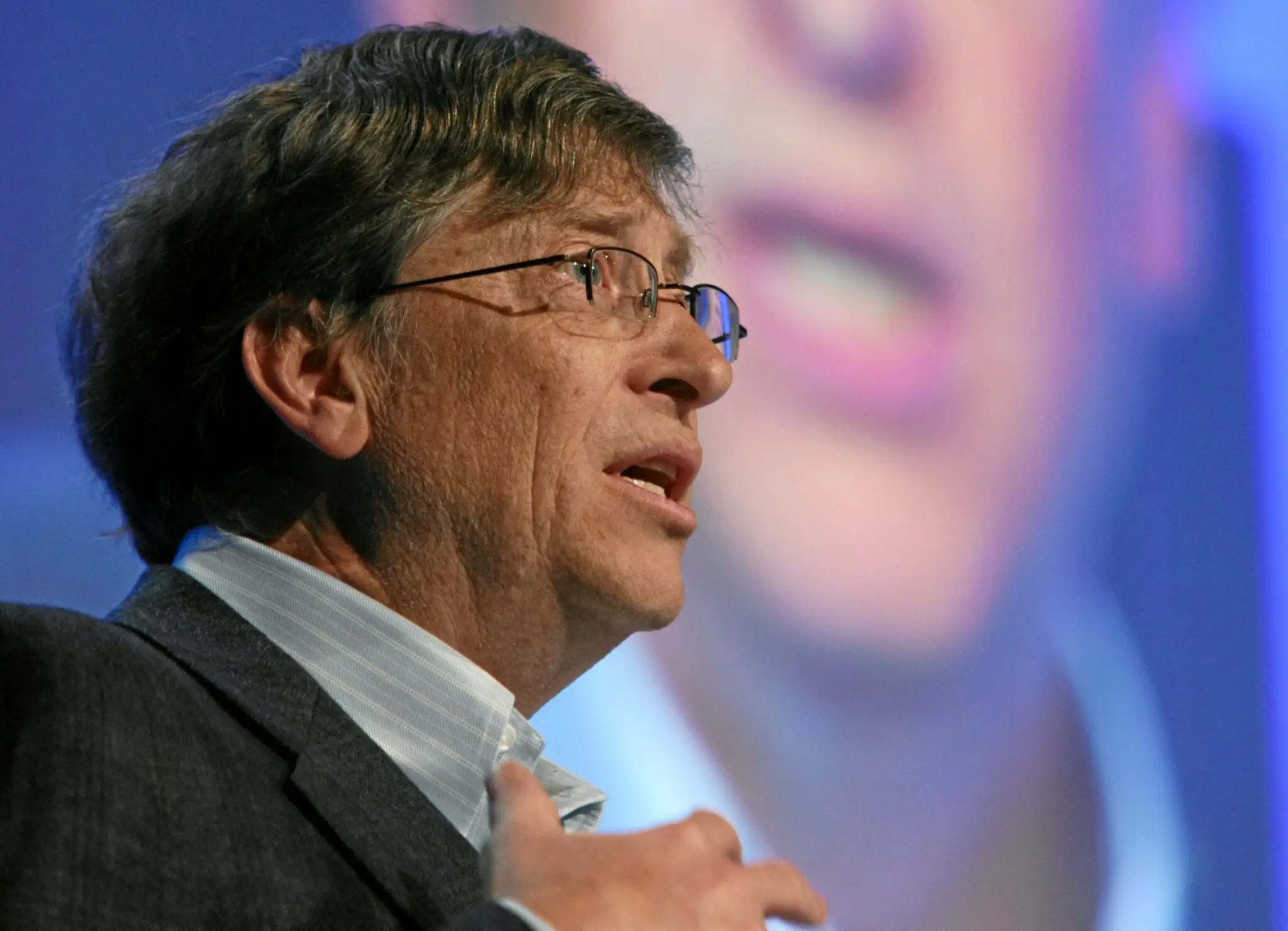











On 4 April 1975, the young programmers Bill Gates and Paul Allen founded Microsoft, a small company with an ambitious goal: to develop software for the first personal computers.
More than 50 years later, Microsoft has become one of the world’s most powerful technology companies, profoundly shaping the way we work, communicate and use technology.
The company remains at the forefront of technological change, investing in artificial intelligence, particularly through its partnership with OpenAI.
The first steps of a small company
A retrospective account describes its beginnings: in 1975 Microsoft recorded first-year revenue of $16,000 and had just three employees, two of whom were its founders, Bill Gates and Paul Allen. Even with only three people, it developed BASIC for the Altair computer.
The 1970s ended with the first signs of growth. The company adopted a formal structure and expanded beyond the United States:
1977: Microsoft formally became a partnership between Gates and Allen. The company sold its BASIC language to Apple.
1978: Annual sales exceeded $1 million for the first time.
1979: Microsoft crossed the Atlantic, with Vector International becoming its official representative in Europe.
The next decade would prove decisive:
1980: Steve Ballmer joined the company. The historical account cited here described him as its chief executive at the time that account was written.
A description of a 1981 photograph shows Microsoft’s young founders, Bill Gates and Paul Allen, in the company’s then-small offices in Bellevue, Washington. Behind them stood large computers the size of refrigerators and shelves of magnetic tape reels.
The account recalls Gates and Allen establishing the business during Gates’s Harvard years and notes that, by 1981, Microsoft employed 85 people. It would go on to become the world’s most valuable company.
A defining decade
Two years later, Microsoft moved from its early products towards the one that would define its identity:
1983: Microsoft announced Microsoft Windows, the product with which its name would become synonymous, offering a user-friendly extension to DOS. Subsidiaries opened in France, Germany and Britain.
It was a decade of growing dominance. Microsoft floated on the stock market, overtook competitors and saw its revenues soar:
1985: The company marked its first decade with sales of $140 million. Its products already included operating systems, programming languages, business applications, hardware and books guiding readers through the emerging computer age.
1986: Microsoft went public, raising $61 million in its initial public offering.
1988: Microsoft overtook Lotus to become the world’s largest supplier of operating systems and applications.
1990: As annual revenue passed $1 billion for the first time, Gates outlined his vision of the future at the COMDEX exhibition.
“Mr Software” and his vision
The Greek magazine Tachydromos, in its issue of 16 October 1991, described Bill Gates as “Mr Software”, whose every move made computer giants IBM and Apple nervous.
The report portrayed William Gates III as the driving force behind multimedia PCs capable of doing everything, or almost everything. Its description gave his age as 38.
The same report argued that Microsoft specialised in the software its rivals could not match. With sales exceeding $4.5 billion, it said, Gates exerted a tight grip on the market, prompting the former dominant players to use every means available to challenge him.
The article also recorded the vision he had expressed as early as 1975:
Six years before IBM launched its first PC, Gates had written in his notes that a computer could be created for every desk and every home.
After millions of dollars in research, the report continued, multimedia computers brought moving and still images, sound and text together in a single portable PC: a small marvel of digital technology that could be carried under an arm, transported over long distances and set up wherever its user wished.
Global dominance
The 1990s were marked by the widespread dominance of Windows and the mass adoption of personal computers:
1993: Windows had 25 million users, making it the most popular operating system of its kind in the world.
1995: Microsoft’s 20th anniversary was marked by Windows 95, which sold one million copies in its first four days.
1997: With revenues above $11 billion, Microsoft drew scrutiny from the US Department of Justice over its monopolistic practices, according to the retrospective chronology.
At the end of the millennium, Microsoft reached the height of its power:
1999: Microsoft became the first company to reach a market capitalisation of $500 billion. Gates and Ballmer described the 1990s as the decade of applications.
The year 2000 marked a new era. Gates stepped down as chief executive, having transformed a small start-up into a global giant:
The historical account describes Gates handing over to Steve Ballmer 25 years after Microsoft’s founding, amid the threat that the company could be broken up. Along the way, it says, Gates had become the world’s richest man, with a personal fortune of $100 billion, while Microsoft employed more millionaires than any other company.
Microsoft’s story has continued ever since, as the company adapts to new technological conditions while maintaining a leading role in the industry.
Its trajectory still reflects, to a considerable extent, the evolution of the digital age itself.