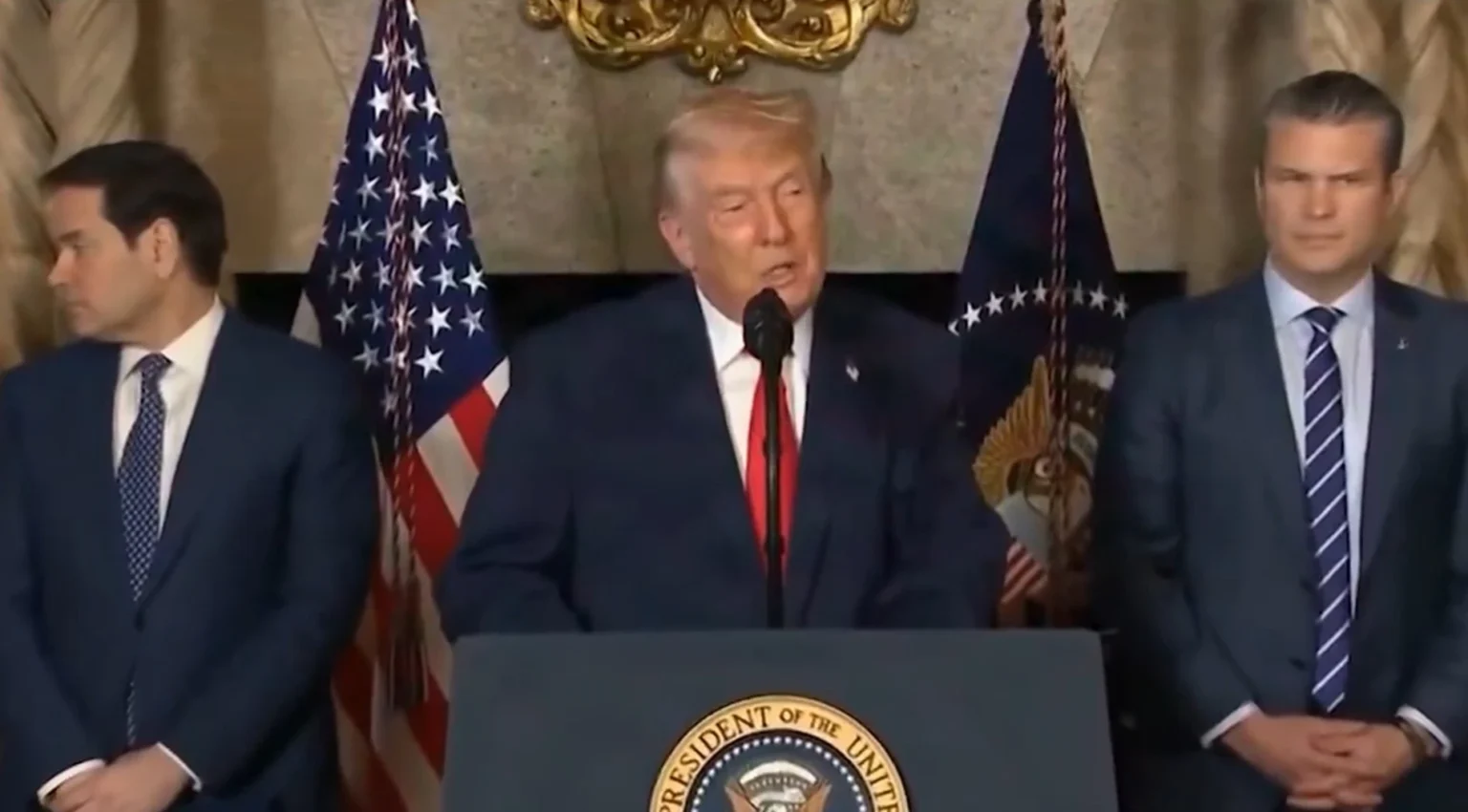






Donald Trump announced a two-week suspension of bombing against Iran, conditional on Tehran accepting terms.
“We received a ten-point proposal from Iran, and believe it is a workable basis on which to negotiate. Almost all the various points of past contention have been agreed to between the United States and Iran,” the US President said.
He said the two weeks would allow an agreement to be finalised and completed.
He described a two-sided ceasefire, implying a corresponding commitment by Iran.
Pakistan's proposal
Pakistani Prime Minister Shehbaz Sharif had urged Trump and the Iranian authorities on Tuesday to agree a two-week ceasefire to allow peace talks.
White House Press Secretary Karoline Leavitt told Axios: “The President has been made aware of the proposal, and a response will come.”
Sharif's appeal came less than five hours before Trump's deadline for an agreement or the start of extensive attacks on Iranian infrastructure.
Pakistan has acted as the principal intermediary between Washington and Tehran in recent weeks.
Axios reported progress during the previous 24 hours, with the proposal offering both sides a temporary way out.
Sharif wrote on X:
“Diplomatic efforts for the peaceful settlement of the continuing war in the Middle East are progressing steadily, strongly and powerfully, with the prospect of substantive results in the near future.
“To allow diplomacy to run its course, I sincerely request President Trump extend the deadline for two weeks.
“Pakistan, in all sincerity, requests the Iranian brothers to open the Strait of Hormuz for a corresponding period of two weeks as a goodwill gesture.
“We also urge all parties to observe a ceasefire everywhere for two weeks, allowing diplomacy to secure a final end to the war in the interests of long-term regional peace and stability.”
Progress before the deadline
Before Trump's announcement, a US official, an Israeli official and two other sources familiar with negotiations told Axios there had been progress, although an agreement before the 8pm Eastern Time deadline still appeared unlikely.
One US official said White House thinking had shifted from whether a deal could be reached to whether it could be reached by eight that evening.
Earlier threats and attacks
Before the deadline, set for 3am Greek time, the United States and Israel intensified strikes against Iran, including civilian infrastructure.
Trump had threatened the destruction of an entire civilisation unless progress was made.
Tehran threatened retaliation that would take its enemies and their allies back to the Stone Age, echoing language Trump had recently used.
From Budapest, US Vice-President JD Vance said intensive negotiations continued until the last moment.
“A whole civilisation will die tonight, never to be brought back again. I do not want that to happen, but it probably will,” Trump wrote on Truth Social on Tuesday.
He continued:
“However, now that we have complete and total regime change, where different, smarter and less radicalised minds prevail, maybe something revolutionarily wonderful can happen, who knows?
“We will find out tonight, one of the most important moments in the long and complex history of the world.
“Forty-seven years of extortion, corruption and death will finally end. God bless the great people of Iran!”
“Our plans are not changing unless there is progress,” he later told Fox News.
Trump had repeatedly warned that, unless Tehran reopened Hormuz and accepted his conditions, including abandoning its nuclear programme, power facilities and bridges would be destroyed.
US forces confirmed strikes against military targets on Kharg Island, close to critical energy infrastructure.
Israeli Prime Minister Benjamin Netanyahu confirmed strikes on bridges, railway junctions and roads.
Responding to criticism from UN Secretary-General Antonio Guterres, political leaders and legal experts that attacks on civilian infrastructure constituted war crimes, Netanyahu said the sites were being used to transport weapons-making materials.
Human chains around energy facilities
Iranian state television showed civilians, including children, forming human chains around energy installations after officials urged public mobilisation.
“More than fourteen million Iranians are ready to sacrifice themselves for their country, including me,” President Masoud Pezeshkian said.
White House rules out nuclear weapons
The White House said the United States would not use nuclear weapons against Iran.
Responding to Democratic social-media accounts interpreting Vance's statement that the United States had weapons it had not yet used as a nuclear reference, it wrote: “The Vice-President did not imply that, idiots.”
Revolutionary Guards threaten regional energy supplies
The Revolutionary Guards threatened to escalate attacks on energy and strategic infrastructure across the Gulf.
They warned that they could deprive the United States and its allies of oil and gas for years if Washington and Israel crossed their red lines and carried out threatened large-scale infrastructure attacks.