





Europe's confrontation with Moscow has intensified after Germany formally attributed the Leipzig Airport drone incident to Russia.
The accusation prompted diplomatic responses, discussion of further sanctions and urgent EU–NATO consultations.
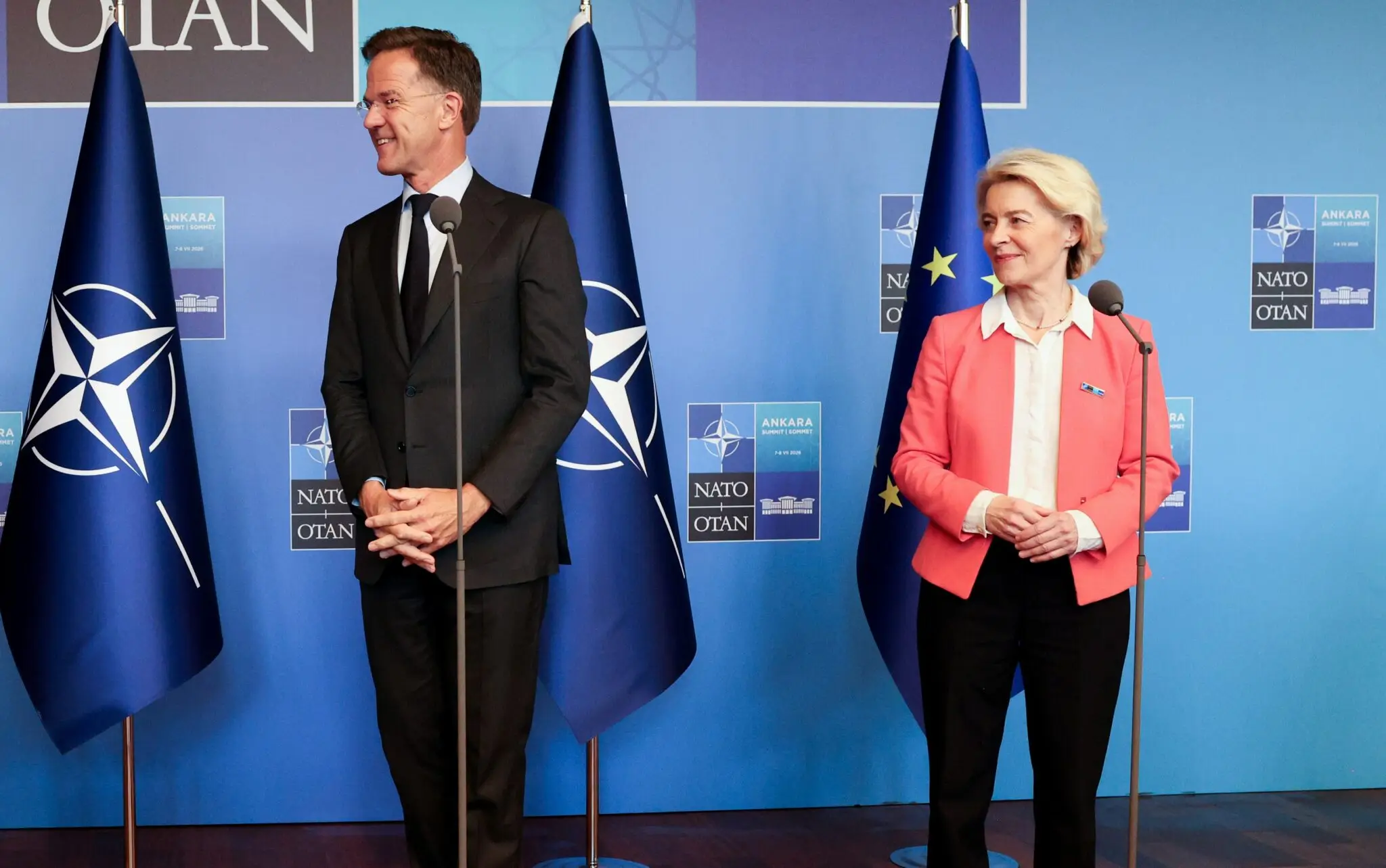
Commission President Ursula von der Leyen and NATO Secretary-General Mark Rutte are meeting to coordinate their response to hybrid threats and strengthen defence cooperation.
Coordinated response
Von der Leyen expressed full solidarity with Germany after Berlin's announcements.
She said Wednesday's meeting with Rutte would address the issue, while foreign ministers would prepare additional sanctions at an upcoming session.
“We will maintain EU unity despite these escalating and serious actions. The German Government has taken strong measures. The message is clear: hybrid attacks will not go without a clear response,” she wrote on X.
Commission chief spokeswoman Paula Pinho confirmed the short-notice meeting, saying it also formed part of closer European and NATO defence cooperation.
A NATO official told Euronews that it would focus primarily on coordination against hybrid threats.
Rutte said the alliance stood alongside Berlin and that the evidence of Russian responsibility was clear.
“NATO will continue strengthening our ability to deter and defend all allies against any threat, including malicious actions such as those seen in Leipzig and elsewhere across the alliance,” he said.
Germany's findings and countermeasures
Interior Minister Alexander Dobrindt said the methods used in the August sabotage incident were familiar from other Russian hybrid operations and the war against Ukraine.
“The German Government therefore concludes that Russia is responsible for the hybrid attack in Leipzig on 4 August,” he said.
Foreign Minister Johann Wadephul said the evidence pointed to Moscow after an explosives-laden drone was found at Leipzig/Halle Airport, a hub for weapons deliveries to Ukraine.
Moscow denies involvement.
Germany announced the closure of Russia's consulate in Bonn and the Russian House cultural centre in Berlin.
Before joining a wider foreign ministers' meeting including Britain, Norway, Canada and Ukraine, Wadephul described a long series of attempts at destabilisation, disinformation, threats, sabotage and aggression against Europe.
The Russian Embassy rejected Berlin's accusations and warned of consequences for new sanctions.
Russia's Foreign Ministry had also condemned Europe in late August for assigning blame before the investigation was complete.
The Leipzig incident
On 4 August, a drone was detected in the airport security zone near a Ukrainian cargo aircraft used to transport military equipment.
The report also described a second drone colliding with an aircraft and preventing it from landing.
Chancellor Friedrich Merz promised a coordinated EU and NATO response.
Allied reactions
Ukrainian President Volodymyr Zelensky warned that Russian airspace, including for commercial aviation, would become increasingly unsafe and see more Ukrainian drones while the war continued.
French President Emmanuel Macron and Italian Prime Minister Giorgia Meloni expressed solidarity with Germany.
“France stands in full solidarity with Germany and supports new European sanctions against Russia,” Macron wrote.
“Attempts to intimidate us or create divisions between allies will not succeed. Hybrid actions against any one of us concern us all and will receive a united response,” Meloni said.
Finnish President Alexander Stubb said allies knew the Russian playbook and would not be intimidated.
“As the strong measures announced by the German Government show, any action against any of us will receive a clear response,” he said.
A wider rise in hybrid threats
After defence ministers met in Wicklow, Ireland, EU foreign-policy chief Kaja Kallas said Russia was conducting increasing hybrid actions intended to frighten Europe into ending support for Ukraine.
“They will not succeed,” she said.
She warned that risks were growing and Europe was plainly not doing enough to stop them.
The EU is forming a high-level group of political and military leaders from member states, Ukraine and the United Kingdom to accelerate efforts to fill defence gaps.
“The aim is to bring together some of the brightest minds in security and defence and deliver genuinely innovative solutions for how we can close these gaps faster and more effectively, especially now that Europe's security situation is so real,” she said.
The initiative comes amid unprecedented security challenges, a reduced US military presence and concern that Russia's escalation in Ukraine could extend into EU territory.
Irish Foreign Minister Helen McEntee said colleagues from Romania, Latvia, Estonia and Germany had described incursions into their airspace and territory over the previous 24 hours.
Romania and Estonia reported drone incursions, while improvised explosive devices were found near a German coal-fired power station.
Arriving for talks, Estonian Defence Minister Hanno Pevkur said Europe needed to prepare for more Russian hybrid-warfare incidents and keep a very clear head.